At the November 12 hearing, HVNA board members claimed overwhelming neighborhood support, economic benefits, regulatory compliance, and the need for another two years of street closure. Their statements deserve scrutiny.
On November 12, the Interdepartmental Staff Committee on Traffic and Transportation (ISCOTT) considered the Hayes Valley Neighborhood Association’s (HVNA) request to extend the recurring closure of the 400 block of Hayes Street for another two years.
What followed was a familiar defense of the closure: enthusiastic accounts of neighborhood activities, claims of broad community support, assurances that organizers had followed the rules, and arguments for giving the permit holder greater long-term certainty.
But this was not simply a collection of residents expressing personal opinions.
Five members of HVNA’s board, including the representative presenting the application, advocated for their organization’s own permit. Several went further, making claims about what the neighborhood wants, what merchants are experiencing, and how successfully the closure has operated.
Those claims were made in a public proceeding intended to inform a SFMTA decision. They warrant examination against the public record.
Trent Berry: When Does a Private Facebook Group Become a Neighborhood Mandate?
HVNA Vice President Trent Berry introduced himself at ISCOTT as a founder and administrator of a private Hayes Valley Facebook group with 2,000 members. He said “quite a few” members had asked him to speak in support of the closure, then proceeded to express support on behalf of the group’s membership. The group predates the Hayes Street closure and is not HVNA’s official Facebook page. Yet Berry, an officer of the organization seeking renewal, invoked its membership in support of that organization’s permit application.
Membership in a private neighborhood Facebook group does not constitute an endorsement of HVNA, much less support for another two years of street closure. Berry identified no poll, vote, or other basis for establishing the group’s position.
A Facebook group is not a neighborhood electorate, and administering one does not confer authority to represent its members on public policy.
Berry also described HVNA’s approach as one of following the rules and doing everything by the book. That assertion is difficult to reconcile with approximately 100 consecutive weeks of HVS reports identifying recurring permit-compliance concerns, including unattended barricades and unauthorized vehicles within the closure, alongside an outstanding administrative complaint seeking revocation.
These reports are not adjudicated findings of every alleged violation. But neither should they be disregarded in favor of an unqualified assertion of compliance. If HVNA maintains that its operations have complied with permit requirements, it should explain how that position squares with the record submitted to SFMTA.
David Robinson: Where did 98% come from?
HVNA Immediate Past President David Robinson identified himself as a longtime resident, homeowner, taxpayer, and participant in the neighborhood association.
Robinson asserted that residents were “pretty much 98% in favor” of the closure. He identified no survey, sample, methodology, or supporting count for that figure. It was presented as a measure of neighborhood sentiment, but his testimony established no factual basis for treating it as one.
A claim of nearly unanimous neighborhood support is not a minor observation. It is an extraordinary assertion in a proceeding where officials are being asked to extend a controversial use of public space for another two years.
Robinson also cited television coverage, the Farmers Market, entertainment programming, and Hayes Valley’s growing popularity as a destination. Those examples may demonstrate public interest in neighborhood activities.
They do not establish that 98% of residents support closing Hayes Street, nor do they establish that the activities require a recurring street closure. If a figure approaching unanimous support is to influence an SFMTA decision, its evidentiary basis should be disclosed.
Jennifer Laska: Who authorized her to speak for the community?
HVNA board member Jennifer Laska told ISCOTT that she originally obtained the closure permit and believed merchants had experienced a lift in business.
She also said she was expressing support on behalf of the community and people she had spoken with throughout San Francisco. There are two separate claims here.
First, the assertion of improved merchant outcomes deserves comparison with the preliminary Hayes Valley Public Life Study findings presented at the October 28 SFCTA Community Advisory Committee meeting. Among 32 surveyed businesses, 41% reported negative impacts, compared with 37% reporting positive impacts. That does not mean every business has suffered. It means the available findings do not support a uniformly positive account of commercial outcomes.
Second, speaking with people throughout San Francisco does not establish authorization to speak for Hayes Valley as a whole. Who authorized HVNA’s board members to represent the views of Hayes Valley businesses and residents who are neither members of the association nor necessarily supportive of the recurring street closure?
Dan Waits: Enjoyable activities are not proof that a street must remain closed
HVNA Treasurer Dan Waits described the Hayes Street closure as a “car-free oasis,” highlighting live music, free games, and opportunities for people of different income levels to enjoy neighborhood activities. He also argued that the closure benefits local businesses, citing friends who travel to Hayes Valley to shop, and characterized it as “a win for all San Franciscans.”
But the central policy question remains unanswered. Why do these activities require the 400 block of Hayes Street to be closed every weekend?
Music can be presented through individual event permits. Farmers markets can operate at appropriately selected locations. Community gatherings can take place in existing public spaces or through separately authorized street events.
The existence of popular activities is not evidence that a standing street closure is necessary to accommodate them.
Vladimir Vlad: Is a Temporary Permit Becoming a Permanent Operating Model?
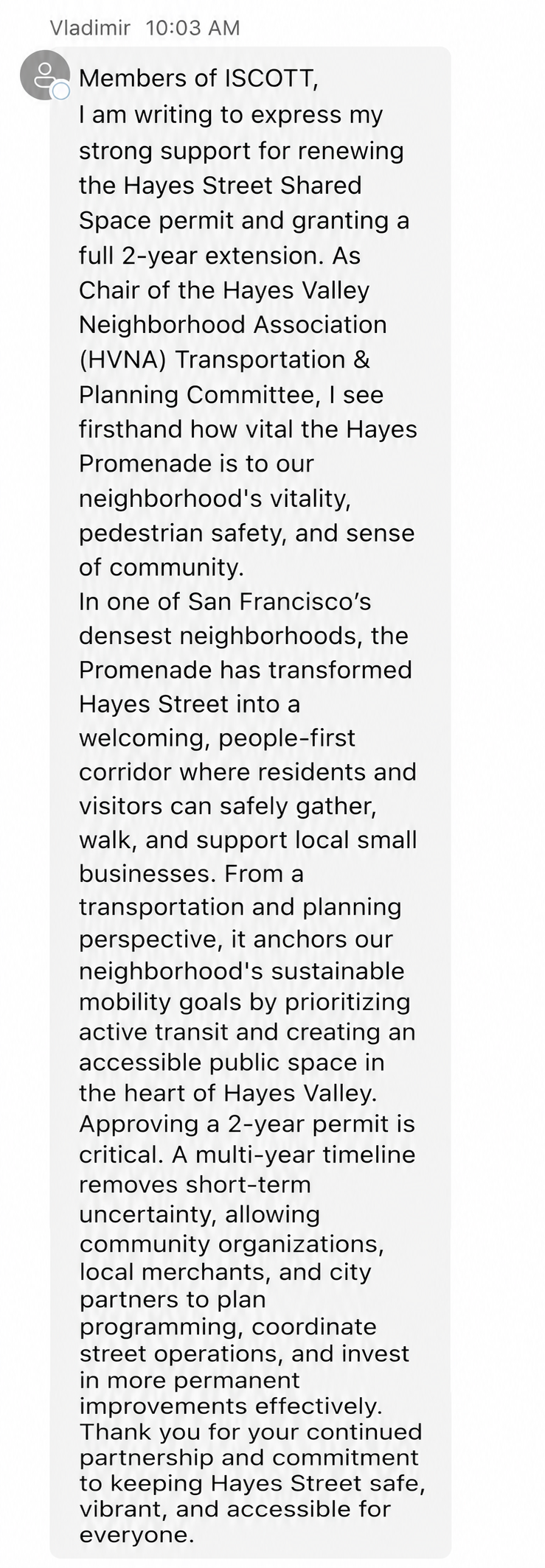
Vladimir Vlad, an HVNA board member and chair of its Transportation and Planning Committee, submitted a statement supporting the full two-year renewal. He attributed pedestrian safety, accessibility, sustainable mobility, and neighborhood vitality to the recurring closure.
Yet the October 28 Public Life Study presentation identified transportation impacts, including a reported 16% slowdown on Route 6 associated with the detour. When questioned, SFMTA staff could not clearly identify the comparison periods underlying that figure. How does HVNA reconcile its sustainable-mobility claims with the effects on public transit?
Vlad also argued that a two-year permit is critical to providing certainty for programming, street operations, and investment in more permanent improvements.
This may be the most revealing argument made at the hearing.
Hayes Street is a public roadway, not an asset owned by HVNA. The organization’s preference for predictable programming cannot, by itself, justify extending a temporary closure or investing in its permanence without broader public evaluation.
After nearly six years, the City has yet to clearly explain under what circumstances Hayes Street would be restored to ordinary circulation. A desire for longer-term certainty is not an answer to that question.
Andrew Seigner: Thirteen hours on paper, twenty-one hours on the street
Presenting the application for HVNA, Andrew Seigner emphasized that the organization was requesting its fewest weekly closure hours to date: 13 hours.
That description is accurate for HVNA’s proposed permit, but it omits the cumulative effect of the separate Saturday Farmers Market permit. The market closes the same block from 7 a.m. to 3 p.m. on Saturdays. HVNA’s proposed hours run from 4 p.m. to 10 p.m. on Fridays and 3 p.m. to 10 p.m. on Saturdays. Together, the two permits account for 21 hours of closure across Friday and Saturday. That is three hours more than at last year’s renewal, following the City’s subsequent accommodation of the Farmers Market earlier this year.
Seigner has also been a public proponent of permanently closing Hayes Street.
After nearly six years of recurring closure and approximately 100 weeks of documented compliance concerns, why is the City considering another two-year extension rather than examining the conditions necessary to reopen Hayes Street to ordinary circulation?
What Did ISCOTT Actually Review?
An organization’s officers may speak for their organization. That does not automatically give them a mandate to speak for an entire neighborhood.
The hearing also included support from individuals associated with the Hayes Valley Farmers Market and the recurring Signature Clothing vendor tent, both connected to activities taking place on the closed block. Their support should not be mistaken for independently established support among the wider community.
IISCOTT is responsible for reviewing street closures, including those affecting transit. Yet the committee forwarded another two-year Hayes Street renewal without substantively examining the documented compliance record or HVS’s outstanding administrative complaint during its public deliberation. Nor did it address the preliminary business and transit impacts presented at SFCTA just two weeks earlier.
With the SFMTA Board scheduled to consider the renewal on December 1, the question is no longer simply what HVNA told ISCOTT.
What evidence did ISCOTT actually consider, and how can another two years of street closure be justified without meaningful examination of the competing evidence and the interests of those who have challenged it?
Related Reading
• The HVNA Myth: Why They Don’t Speak for Hayes Valley
• Our Statement Following the 2025 SFMTA ISCOTT Hearing
• Hayes Street Closure: A Documented Timeline